

Quick Summary
To collect family stories for a gift, first decide who will receive it and what format suits them, then set a deadline and work backward. Ask relatives specific, open-ended prompts tied to photos or single memories, record with their consent, and check names and dates before printing.
- Choose the recipient and format first: a keepsake book for long stories, or a recordable ornament for a short spoken message.
- Set the final delivery date first, then work backward through planning, collection, organizing, proof and production.
- Ask specific prompts about one photo or one memory, and avoid sending a long list of questions in the first message.
- Ask permission before recording, and offer every speaker a review of their material before it is printed.
- Review the full proof before ordering, since a wrong name or missing page cannot be fixed after printing.
Table of Contents
- Start With the Gift: Who Is It For and What Should It Hold?
- Build a Timeline and Checklist Before You Ask Anyone
- Family Story Prompts and Questions to Ask Family Members About Their Lives
- How to Record Family Stories From Relatives Near and Far
- Organizing Family Stories Into a Finished Gift
- Booking Your Mom's Keepsake Book or Recordable Ornament
- Frequently Asked Questions
Start With the Gift: Who Is It For and What Should It Hold?
Last Updated: November 2, 2026
Family stories make the best gifts when you plan them from the start. Before you ask a single relative a question, decide who will open the gift and what you want it to hold.
A family story gift is a collection of memories, photos, and words gathered into one lasting object. Most people give it to a mother, grandmother, or stepmother on a birthday, Mother's Day, or Christmas.
Matching the Project to the Recipient and Occasion
Start by answering three simple questions:
- Who is the recipient? Think about how she spends her time and what she values.
- What is the occasion? A birthday calls for celebration; a milestone like retirement calls for a look back.
- How will she use it? Some want something to display; others want a book to read again and again.
Match the format to her personality. A quiet, private mom may prefer a hardcover book she can read alone. A social mom may enjoy a recordable ornament she can share with guests during the holidays.
Quick format guide:
- Keepsake book: Best for long, detailed stories and many photos.
- Recordable ornament: Best for a short spoken message from a loved one's voice.
- Both: Best for a big milestone when you want a written and spoken tribute.
Our personalized keepsake book for Mom lets you add up to 13 photos and your own words, so it works well when you have lots of material. If you want to keep it simple, a recordable Christmas ornament holds up to 30 seconds of a voice message.


Build a Timeline and Checklist Before You Ask Anyone
Plan your timeline before you contact relatives. A clear schedule keeps the project from dragging on and gives everyone a deadline.
Work backward from the date you need the gift. Then allow time for each stage:
- Planning: Choose the recipient, format, and theme.
- Collection: Gather photos, recordings, and written memories.
- Organizing: Sort, label, and fact-check the material.
- Design and proof: Build the gift and review it before printing.
- Production and shipping: Allow time for printing and delivery.
Give yourself extra room during the holidays. A simple checklist helps you track progress:
- Recipient and occasion chosen
- Format selected (book, ornament, or both)
- Deadline and delivery date set
Watch out: Many people start collecting without a deadline and end up rushing. Set the final date first, then work backward.
Family Story Prompts and Questions to Ask Family Members About Their Lives
Good prompts get good answers. Open-ended questions invite a full story instead of a one-word reply. Ask about specific moments, not broad topics.
Try questions like these:
- What is your earliest memory of your mother?
- What did she teach you that you still use today?
- What family tradition meant the most to you growing up?
Use photos to spark memories. Show a relative a picture and ask, "Where was this taken, and what was happening that day?" Photos often unlock stories a plain question cannot.
Here is a simple way to organize your prompts:
| Theme | Sample Prompt | Best Source |
|---|---|---|
| Childhood | What was your favorite thing to do as a kid? | Parents, older siblings |
| Family life | What holiday traditions did we always keep? | All relatives |
| Turning points | When did you first feel proud of her? | Close friends, partners |
| Everyday moments | What did she cook that you still crave? | Anyone who shared meals |
How to Record Family Stories From Relatives Near and Far
Recording a conversation captures the speaker's voice, tone, and pauses, details that disappear in written notes. The challenge is matching the method to the relative: some will sit for an in-person interview, some live across the country, and some dislike being on camera or won't write anything down.
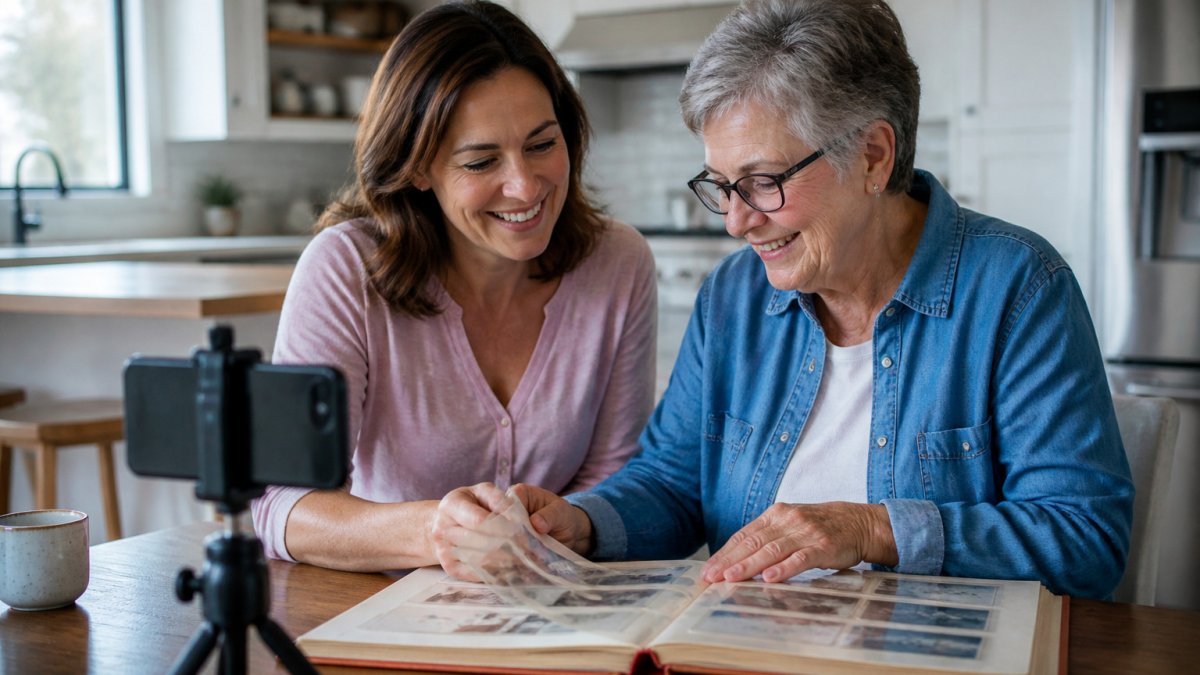
!An adult daughter sitting beside her mother at a kitchen table, both smiling as they look through an old family photo album while a smartphone records their conversation
Choose the Collection Method That Fits the Relative
Use this comparison to pick a method before you reach out, so you don't waste a reluctant relative's goodwill on the wrong format:
| Method | Best for | Trade-offs |
|---|---|---|
| In-person conversation | Close relatives, older speakers, emotional stories | Requires travel and a quiet room; hardest to schedule |
| Phone call | Remote relatives who are comfortable talking | No visual cues; you must take notes or record with permission |
| Video call | Relatives who want to show photos or objects | Tech setup can distract; test the link first |
| Voice notes or voice memos | Reluctant or busy relatives | Short and fragmented; you must stitch clips together |
| Written prompts by email or text | Relatives who dislike speaking on record | Slow replies; answers are often brief |
A common pattern is to combine two methods: a phone call for the main interview, then a follow-up text asking for one photo and one written memory. This keeps the request small and gives you material in more than one format.
Make Participation Easy for Reluctant or Remote Relatives
Most people say yes to a small, specific request and no to an open-ended project.
For relatives who dislike technology, offer to call at a set time and handle all the recording yourself.
Watch out: Don't send a long list of questions in the first message. A wall of prompts reads like homework and is the most common reason relatives go quiet.
Record Clean Audio and Video
Follow these steps to record well:
Personalized Keepsake Book for Mom – Mom, This Is Our Story →
- Choose a quiet room with soft furnishings and few distractions.
- Test your phone or recorder before the conversation starts, and check the file plays back.
- Ask one question at a time and let the person finish before you speak.
- Keep the first session short, about 15 to 20 minutes, and schedule a second session if the person is comfortable.
- Save the file right away and name it with the date, speaker, and topic.
Many relatives feel nervous on camera or on a recording. Start with an easy question about a happy memory, and turn the camera away if the person prefers audio only.
Handling Consent, Privacy and Sensitive Memories
Always ask permission before you record anyone. Explain how you plan to use the recording and who will see it.
Some memories are painful, such as illness, divorce, or loss. Let relatives choose what they share: "Only tell me what you feel comfortable with." Store recordings in a private folder, and do not post them publicly without permission.
A practical consent step is to offer every speaker a review before printing.
Transcribe and Edit Without Losing the Speaker's Voice
Transcription turns a recording into text you can lay out in a book. You can transcribe by hand, use a speech-to-text app, or ask a fast typist in the family.
Edit in three passes:
- Clean-up: remove filler words, false starts, and long pauses, but keep the speaker's own phrasing and dialect.
- Fact-check: confirm names, dates, places, and relationships with the speaker or another relative.
- Sensitivity review: remove or soften any detail the speaker asked you to leave out, and re-check that no third party is embarrassed by the material.
Keep a short note of who said what and when, so captions and credits are accurate. A wrong date or misspelled name can undercut an otherwise lovely story, and the speaker is the best person to catch it before printing.
Organizing Family Stories Into a Finished Gift
Once you have your material, sort it into a clear order. Group stories by theme or by time period.
Transcribe your recordings so the words are easy to read. Trim long pauses and remove any details the speaker asked you to leave out.
Gathering photos from many places can be the hardest step. Our guide on how to organize photos for a keepsake book walks through sorting them into a clean order.
Lay Out the Gift So It Reads Like a Present
A finished gift needs a deliberate order, not just a pile of stories. A simple structure that works for most keepsake books is:
- Opening page: the recipient's name, the occasion, and a one-line dedication.
- Contents or timeline: a short list of the stories or the years they cover.
- Story sections: group by theme (childhood, family life, turning points) or by decade, whichever fits the material.
- Photo pages: pair each photo with a caption that names the people, place, and year.
- Closing page: a short note from you and a list of contributors.
Write captions in plain language: "Mom and her sister, summer 1968, at the lake house." Captions do more than label a photo; they preserve the context that future readers will otherwise lose. If a photo shows people who have not consented to appear in a printed gift, ask before you include it, or crop or omit the image.
Proof, Print, and Package With the Deadline in Mind
Review the full proof before you order.
Plan production and shipping backward from the delivery date.
Presentation matters as much as the contents.
Watch out: Don't leave the proof review to the last week. A single wrong name or a missing page discovered after printing cannot be fixed in time for the occasion.
Keep the finished gift simple and easy to read.
Booking Your Mom's Keepsake Book or Recordable Ornament
When your stories are ready, place your order. Start with the format you chose in the planning stage. A book suits long stories and many photos, and an ornament suits a single heartfelt message.
Before you order, check these details:
- Your deadline and the time needed for production and shipping
- The number of photos and words you plan to include
- Whether you want a book, an ornament, or both
The Mom, This Is Our Story keepsake book costs $69.99 and takes 5 days to produce after you approve the proof. The Christmas Voice Keepsake costs $39.99 and is a good add-on for the holidays. Order early so your gift arrives on time, especially during busy seasons.
Frequently Asked Questions
How do you collect family stories?
Start by choosing one recipient and one occasion, then decide what the gift should hold: photos, spoken memories, written messages or all three. Ask two or three relatives to name the people, places and moments they remember most, and gather existing photos from phones, cloud accounts and albums in one shared folder. Send each contributor a short list of prompts instead of an open request, since specific questions produce longer, more vivid answers than broad ones. Set a deadline about four to six weeks before the gift is needed so there is time to review material, follow up on gaps and plan for production and shipping.
What questions should I ask relatives about family history?
Ask questions that invite a scene rather than a yes or no. Good examples include: What was your first home like? What did we eat on holidays when you were growing up? Who in the family taught you something you still use today? What did you want to be when you were ten? Ask about specific people and objects, such as a grandparent's handwriting or a family recipe, because concrete details trigger memories. Keep the list to eight to ten questions per session, and let your relative skip any that feel too personal.
How do I record a family member telling a story?
Use a phone's voice memo app or a dedicated recorder placed close to the speaker, and test the audio for ten seconds before the conversation begins. Tell your relative the recording is for a gift and confirm they are comfortable being recorded. Let them talk without interrupting, then ask short follow-up questions such as 'What happened next?' or 'Who else was there?' Save each recording with the relative's name and date, and note any names or dates they mention so you can check them later.
How do I organize family stories into a keepsake gift?
Sort material into themes such as childhood, traditions, work and milestones, then pick the strongest three to five stories for the gift. Transcribe the recordings, trim filler, and check names, dates and places with at least one other relative. Match each story to a photo where possible, and keep each entry short enough to read in a minute or two. Once the order is set, approve a final proof before printing, because most errors are easier to fix at that stage than after the book arrives.
Start with one person and one story, then let the project grow from there. Gather the material, approve the proof, and give your mom a gift she can hold and replay for years. Shop the keepsake book collection and make the story yours.
